


What is thermal shock?
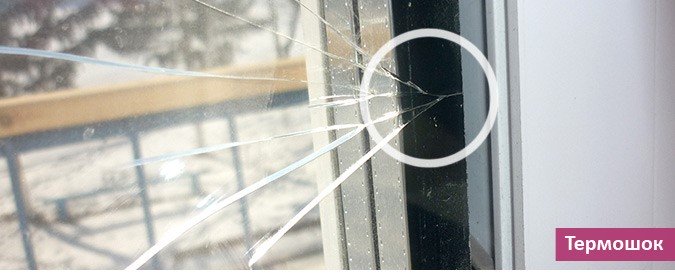
Very often, during the operation of double-glazed windows, elementary rules are violated that lead to sad consequences – double-glazed windows simply burst. Let us consider in more detail one of the causes of cracks – thermoshock.Thermoshock – spontaneous destruction of glass as a result of the development of internal stresses during its uneven heating-cooling.
Let’s start with the fact that glass in the production of double-glazed windows does not cut them, but breaks them. That is, the glass is not cut, it scratches and breaks by scratch. Microcracks necessarily appear at the fracture site. Whether we want it, we do not want it – this is a physical process, there is no escape from this. And when the window is operated, it then heats up, then cools, the double-glazed window and the profile begin to “breathe”, “work”.
At one “beautiful moment”, under a confluence of circumstances, a temperature drop is obtained on one sheet of glass, and microcracks on the edge of the glass begin to work like wedges. When there is a temperature difference of about 40 degrees Celsius on the glass – it cracks and it does not matter what kind of glass it is – with a coating, without a coating, with a tinting film or transparent.
Why does a thermal shock appear on the double-glazed window?
Thermoshock is most often on the south side, rarely on the north side of the orientation of the facades. A crack due to thermal shock can be very well distinguished from any other crack if you look at the glass more closely and remove the beads. If the crack comes out at an angle of 90 degrees to the end of the glass and in the place from where the crack comes out, there are no chips, no chips – then there is a high probability that this is a thermoshock. Cracks from thermal exposure always go at an angle of 90 degrees, both to the end of the glass and from the surface. The crack can be further spread as you like, it came out at 90 degrees and went further, at any angle. It can finish its journey or can break into 2 or 3 cracks.
At a low thermal voltage, one crack with an angle of 90 degrees comes out and at a higher voltage several rays already come out, the angle is still the same 90 degrees.
The risk of thermal shock is primarily affected by the orientation of the facade, where there is sun, where more heat comes from the sun. The type of glass that is used and the various absorbent films are also affected, because the glass heats up much more intensively.
Not so much dangerous is the heating of the glass, as its unevenness, for example, if there is a visor near the window, or some part of the window enters the opaque zone – it turns out that part of the glass is under direct rays of the sun, and part is in the shade.
If this glass is tinted, or with an absorbent athermal film, then it heats up much more intensively under the action of the sun, and the part that is under the visor, it does not heat up or heats up much more slowly. As soon as there is a temperature difference of 40 degrees – the glass will crack, as a rule, this happens more often in early spring or late autumn, when on one side the Sun is already warming it in the summer hot, but there is still cold air outside. Therefore, if we have sources of uneven heating, some shadows fall on the glass, then this is very critical at this time of year.
In addition to exterior structures that can create shade and thereby cause uneven heating, it can also be caused by internal elements, especially sun protection structures such as blinds. Blinds can be very critical in terms of thermal shock and more dangerous are those blinds that are attached as closely as possible to the surface of the glass. There are blinds that are built into the bead itself and completely cover the entire surface of the glass. And the blinds that move, that can be assembled – they are more dangerous.
The color of the blinds also affects. Oddly enough, but white blinds are among the most dangerous, because the white color reflects about 70% of the energy back to the glass. In this case, the hostess can lift these blinds and close the upper part of the window, so that the sun does not shine in her eyes, and leave the lower part open – it turns out that the upper part of the glass it will heat up much more intensively and glass destruction can occur due to thermal shock precisely due to the fact that the blinds or roller blinds were tight to the glass.
It is not allowed to create such uneven heating and it is better to avoid installing any building materials, cluttering on the windows, especially on the south side.
A few more fairly common cases of thermal shock
In summer, in the sun on the south side, our glasses can heat up to a temperature of 100 degrees. And when we splash cold water on the glass, they crack, they are not designed to withstand such a load. Glasses that withstand thermal stress are tempered or thermally hardened glasses, which, for example, are installed in ovens. When stretching ceilings, heat guns are used. Heat guns radiate heat energy in a directed stream and if the installers who stretch the ceilings turn the gun on the glass and left it for a while, then the glass, of course, will not withstand such a concentrated flow of hot air and crack.
Also, in new buildings, heat guns are often used to dry the plaster and in the same way the heat gun is directed at the glass, then they leave and after a few hours they return and notice that the glass has cracked. The heat gun is removed, everything is hidden, window cleaners are called, cracked glass is shown.
Does applying sunscreen lead to cracks in the glass?
Window tinting films can affect (even in theory) only one of the reasons – thermal shock. The films do reflect and absorb some of the solar energy. But films are not the only reason for non-normative heating of glass: it can be curtains placed too close, stickers on windows, heating batteries and even the border of the shadow falling on the glass.
Items placed on the windowsill (large flower pots, boxes, a stack of books), or glued to the inner glass of the double-glazed window (posters, ads, newspapers) can lead to cracks. All this prevents the air from circulating, prevents the removal of heat from the window and as a result , different parts of the glass heat up differently. Let’s hazard a guess that, all other things being equal (edge quality, glass thickness, glass surface quality, etc.) thermal shock is higher on smaller packages because the larger one retains the possibility of lensing, there is room to deform. The larger the dimensions of the glazing, the higher the mechanical stresses between the heated and cold areas of the glazing.
In addition, a significant linear expansion of glass panels as a result of heating by insolation can lead to their destruction in the absence of temperature gaps between the glazing elements and the profile.
Below are the main factors that can lead to the destruction of glass:
- High absorption coefficient of solar radiation. This figure can be high both because of the color of the glass in the mass, and because of the dark tinting film. The higher this indicator, the greater the risk of destruction The shadow falling on the facade causes the presence of illuminated and unlit zones on the surface of the glass.
- The presence of a “heat bag”, that is, an area from which excess heat is not removed (the presence of thermal insulation behind the double-glazed window, the presence of a niche in the upper part, etc.).
- The presence of two or more energy-saving coatings in a double-glazed window. In fact, it is a special case of a “heat bag”.
- Orientation and inclination of the elements of the facade / building, they affect the insolation of the glass surface.
- Quality of cutting/processing of glass edge, glass thickness. A well-treated edge reduces the likelihood of a thermal shock.
- Climatic parameters: time of year, fluctuations in daily temperature, latitude of the construction site, etc.